Content warning:
This blog includes personal reflections on childhood trauma, addiction, suicide, and housing insecurity. While the conversation is thoughtful and non-graphic, please read with care.
If you or someone you know needs support:
- Mental Health:Samaritans – 116 123
- Addiction:Talk to Frank – 0300 123 6600
- Housing Support:Shelter – 0808 800 4444
Mental Health: Samaritans – 116 123
Addiction: Talk to Frank – 0300 123 6600
Housing Support: Shelter – 0808 800 4444
Dougie’s Foster Care Experience
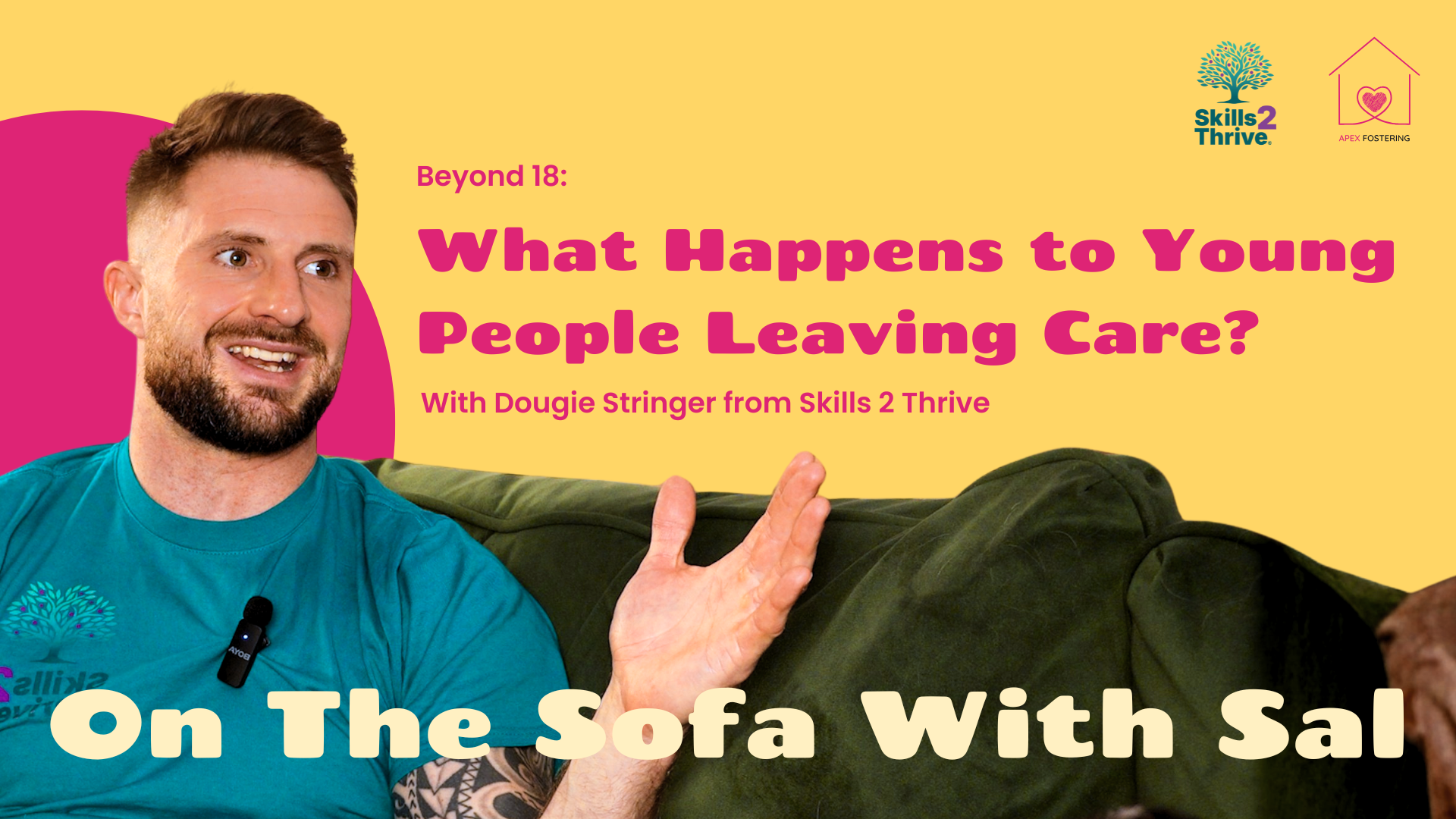
When Dougie Stringer entered foster care at age 11, his life changed. After his mum passed away and his dad became alcohol dependent, he and his two sisters were placed with a foster family who gave them a space to thrive in, together.
“They kept us together. That made all the difference,” Dougie told Sal in the episode of On the Sofa with Sal discussing support available for care leavers.
With a great foster family, this was the start of a new chapter. But, as is often the case, stability in care doesn’t automatically prepare young people for what comes next.
The Truth About Leaving Foster Care in the UK
At 16, Dougie made what he calls a mistake, and moved back in with his dad. The chaos returned quickly.
“It reminded me exactly why I went into care in the first place. But I didn’t want to be seen as different. I didn’t talk about being in care at all, not even at uni. I just wanted to be ‘normal’,” Dougie shared.
It wasn’t until ten years later, at 26, that Dougie felt ready to reconnect with his care experience and use it to help others. That journey, from surviving to supporting, wasn’t straightforward. And it highlights what so many care-experienced young people face: the system moves on, but the impact doesn’t.
Even today, the transition out of foster care is still described by many as a “cliff edge.” While some young people might have a personal adviser or access to a small leaving care grant, that support is often too little, too late.
“Support every eight weeks isn’t support. It’s a check-in. And young people deserve more than that.”
The Numbers Don’t Lie
Leaving foster care in the UK can be frightening. And the national statistics paint a stark picture:
- 1 in 4homeless people are care experienced
- 1 in 4people in prison spent time in care
- 39%of care leavers are not in education, training or employment
- Care leavers are 5x more likelyto die by suicide
1 in 4 homeless people are care experienced
1 in 4 people in prison spent time in care
39% of care leavers are not in education, training or employment
Care leavers are 5x more likely to die by suicide
“We talk about preparing kids for adulthood, but we’re not doing it. And they’re paying the price.”
Skills 2 Thrive: A Platform Built on Experience
That’s why Dougie founded Skills 2 Thrive; a mentoring and digital learning platform designed to equip care-experienced young people with the real-world skills they need to live independently and confidently.
It covers:
- Money management: budgeting, credit, debt, savings
- Housing knowledge: tenancy rights, how to avoid crisis
- Health and wellbeing: mental health, coping tools, self-awareness
- Employment prep: CV writing, finding work, setting goals
Money management: budgeting, credit, debt, savings
Housing knowledge: tenancy rights, how to avoid crisis
Health and wellbeing: mental health, coping tools, self-awareness
Employment prep: CV writing, finding work, setting goals
“It’s not just a training course. It’s support from someone who gets it.”
Young people can complete short modules, earn certificates, and access crisis support tools, all via mobile. For those in the North West, one-to-one mentoring is also available. Dougie and his team are working towards expanding this offering across the country.
What Foster Carers Can Do, Before and After 18
Dougie is passionate about the role foster carers play – both before and after the person in care has turned 18.
Here are some key ways carers can help:
- Teach life skills early: Budgeting, cooking, managing appointments. If the young person in your care has access to Skills 2 Thrive, you can structure skill development in conjunction with modules.
- Encourage responsibility: Saturday jobs, cleaning routines, savings goals
- Create continuity: Offer emotional connection even after they move out
- Stay connected: Invite them back for Sunday dinner or check in regularly
Teach life skills early: Budgeting, cooking, managing appointments. If the young person in your care has access to Skills 2 Thrive, you can structure skill development in conjunction with modules.
Encourage responsibility: Saturday jobs, cleaning routines, savings goals
Create continuity: Offer emotional connection even after they move out
Stay connected: Invite them back for Sunday dinner or check in regularly
“You might not keep their room, but you can still hold space for them.” Sal comments.
Even small gestures, like being invited to Christmas dinner, can remind care leavers they’re still part of a family.
Finding Hope After Care: Dougie’s Message to Young People and Those Who Support Them
Leaving foster care in the UK can feel daunting, but it doesn’t have to mean doing it alone. Support is available, and we are working towards making it easier to access.
Whether you’re a young person wondering what comes next, or a foster carer trying to guide someone through that transition, both Dougie and Sal’s story can be summarized into this: there is life, purpose, and hope beyond 18.
It starts with small things; knowing how to budget, who to call when something breaks, how to find your people. But it’s the relationships that matter most. A carer who checks in, a mentor who believes in you, and a community that welcomes and includes you.
“Find your purpose. You’re not your past. And you’re not on your own,” Sal and Dougie agrees.
And if you’re someone who can be part of that support system, through fostering, mentoring, or simply showing up, your impact could last a lifetime.
Want to help or get help?
- Watch the full conversation:Leaving Foster Care in the UK: Dougie Stringer on Life After Care and Skills 2 Thrive
- DiscoverSkills 2 Thrive,
- Learn about fostering onour blog, or follow us on IG, YT, LI, FB
Watch the full conversation: Leaving Foster Care in the UK: Dougie Stringer on Life After Care and Skills 2 Thrive
Discover Skills 2 Thrive,
Learn about fostering on our blog, or follow us on IG, YT, LI, FB
Interested in fostering with Apex? Contact us for a no-pressure chat.
Sources for statistics:
1) House of Commons Education Committee Children’s Social Care Report (2025), Page 4, 73